Two Mistakes to Avoid When Crafting Your Foundation’s Communication Plan
Riya Ramaswamy
Published: 02/24/2026

Why do donors leave? For half of them, the answer is simple: poor communication.
You’ve probably heard this statistic before, but it doesn’t make it any less scary. We go through all this work to find and bring donors, but it’s the communication from your organization that ultimately drives them away.
So, what can we do? In the AHP Voice and Storytelling Masterclass, Michael Beall, Principal Consultant and Communications Practice Leader at Accordant, dives into mistakes and pitfalls foundations and how you can shift your strategies to improve your foundation’s communication. Here are two that stick out.
Mistake #1: A Lack of Clarity in Messaging
Donors and prospects have more options than ever. So why should they choose your organization over another?
That’s where your specificity comes into play. Instead of just answering the questions of “who are we” and “what is our mission,” you should communicate “why now” and “what differentiates our foundation.”
When communication is unclear, donors find it difficult to understand why their support matters.
Solution: Find Your Unique Voice
Your foundation’s unique voice serves as the bedrock for everything that comes next. Before you even begin the campaign planning stage, your first step should be crafting how you want to sound when you step up and speak in that first-person voice on behalf of the foundation in print pieces, emails, and social posts. In marketing lingo, this is called your “lead” or “dominant” voice.
Your mission statement likely has “us” and “we” written in it. Your lead or dominant voice should feel genuine and specific, so when donors read it, they know exactly how to view your organization.
One exercise to tackle this is going through your mission statement and highlighting every first-person pronoun you see—the “we’s” and “us’s.” Is it clear who is being referenced? Hint: it should be the foundation.
You should be aiming for consistency to communicate clearly and effectively. By clearing up ambiguity, you are cutting through the clutter.
This unique voice will help you craft a narrative for your foundation, so donors understand what sets your foundation apart and why their involvement is needed now.
Mistake #2: Not Having a Communication Strategy
Marketers know the marketing funnel all too well. It begins with awareness and eventually leads to a consumer’s loyalty. But how does that relate to philanthropy?
Michael argues that the foundation sits at the bottom of the marketing funnel after a donor has had experience with your organization. You’ve built that loyalty. However, the mistake occurs when you presume donor loyalty without knowing who your audience is or what your value proposition provides. You need to establish footing first. You wouldn’t decorate a house before building it first, would you?
This again goes back to the “why our foundation” question from mistake #1.
Solution: Enter the Room Prepared
If you approach your marketing team for next steps or campaign planning assistance without a clear strategy, they won’t be able to assist you to their greatest ability. Before reaching the marketing stage, you should:
- Know who your audience is (new donors, grateful patients, etc.)
- Have a clear lead or dominant voice aligning with your foundation's brand
- Understand what sets your foundation apart from others
Remember that you should think about philanthropy communication like glue, not bait. It is about holding a relationship together and not just reeling a donor in. Marketing campaigns are a key aspect of acquiring and retaining donors, but for a campaign to be effective, you need to provide a meaningful message that will make the relationship stick.
One bonus step is conducting testing before you approach the campaign stage. Yes, typically the marketing department runs this step, but is there a gap that the foundation can fill? You know the foundation better than the marketing team, so can you nuance the overall brand and address any missed opportunities.
A Practical Example
You cleaned up your mission statement and are prepared with your insights to bring to the marketing team. What now?
Here’s an example of how a children’s hospital could potentially use the information they gathered to run an advertisement.
The advertisement reads: Future Philanthropist. Five years ago when Allena was just six years old she survived a deadly car crash. She spent an entire year at the hospital recovering. Recently she learned that philanthropy dollars also had made it possible for her mother to stay with her during that year. Last week she met with one of those donors and made them a promise to pay it forward. Aren’t children amazing.
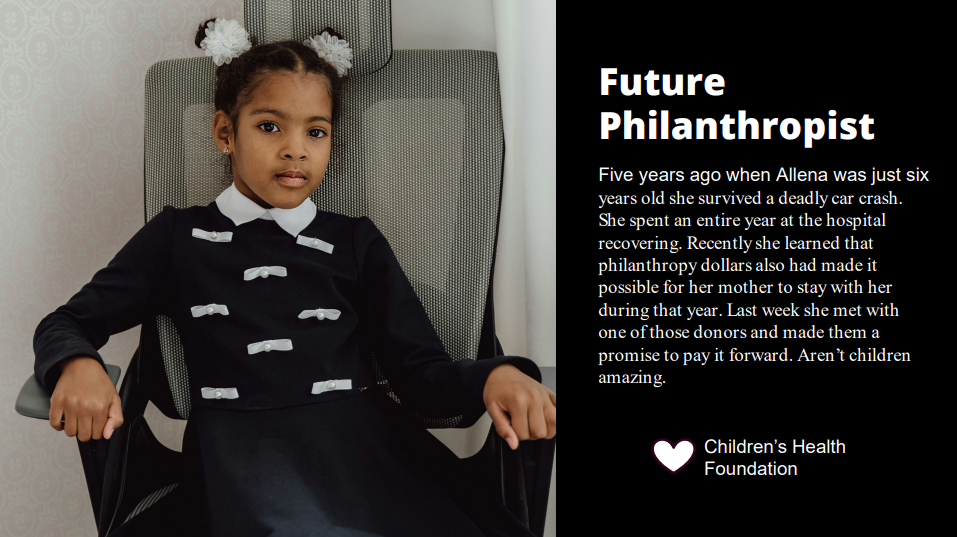
The lead/dominant voice in this ad is incredibly clear and human. Plus, who is better as a voice for the hospital or foundation than somebody who believes in it? By letting the story speak for itself, the message highlights the donor’s impact without “heroizing” the patient or the caregivers.
Of course, we can’t see the prep work the foundation did before this advertisement was run, but the result is evident: the audience and voice are clear, and the message reinforces the impact of donor support and the power of philanthropy. They don’t have to explicitly state what happened inside the hospital to validate the mission. The human outcome speaks for itself.
Michael offers one final tip when creating messaging for effective communication. Talk to your donors like they are friends, not strangers. We build trust with people we understand, not with those we place on a pedestal.
Keep it simple. A unique voice, being prepared with strategy, and leading with care are communication essentials. That’s where trust grows, and how you can cultivate a relationship that lasts.
Ready to find your foundation's unique voice? Register for our
Voice and Story Masterclass to master communication strategy like a marketer.